
 A US Army officer who testified in President Donald Trump's impeachment probe was pushed out of his White House job on Friday, his lawyer said. Lieutenant Colonel Alexander Vindman was escorted out of the White House where he worked on the National Security Council, with his lawyer calling the move an act of revenge by the president. "Vindman was asked to leave for telling the truth," lawyer David Pressman said.
Lt. Col. Alexander Vindman, a key witness in President Trump's impeachment inquiry was fired from his job at the National Security Council.
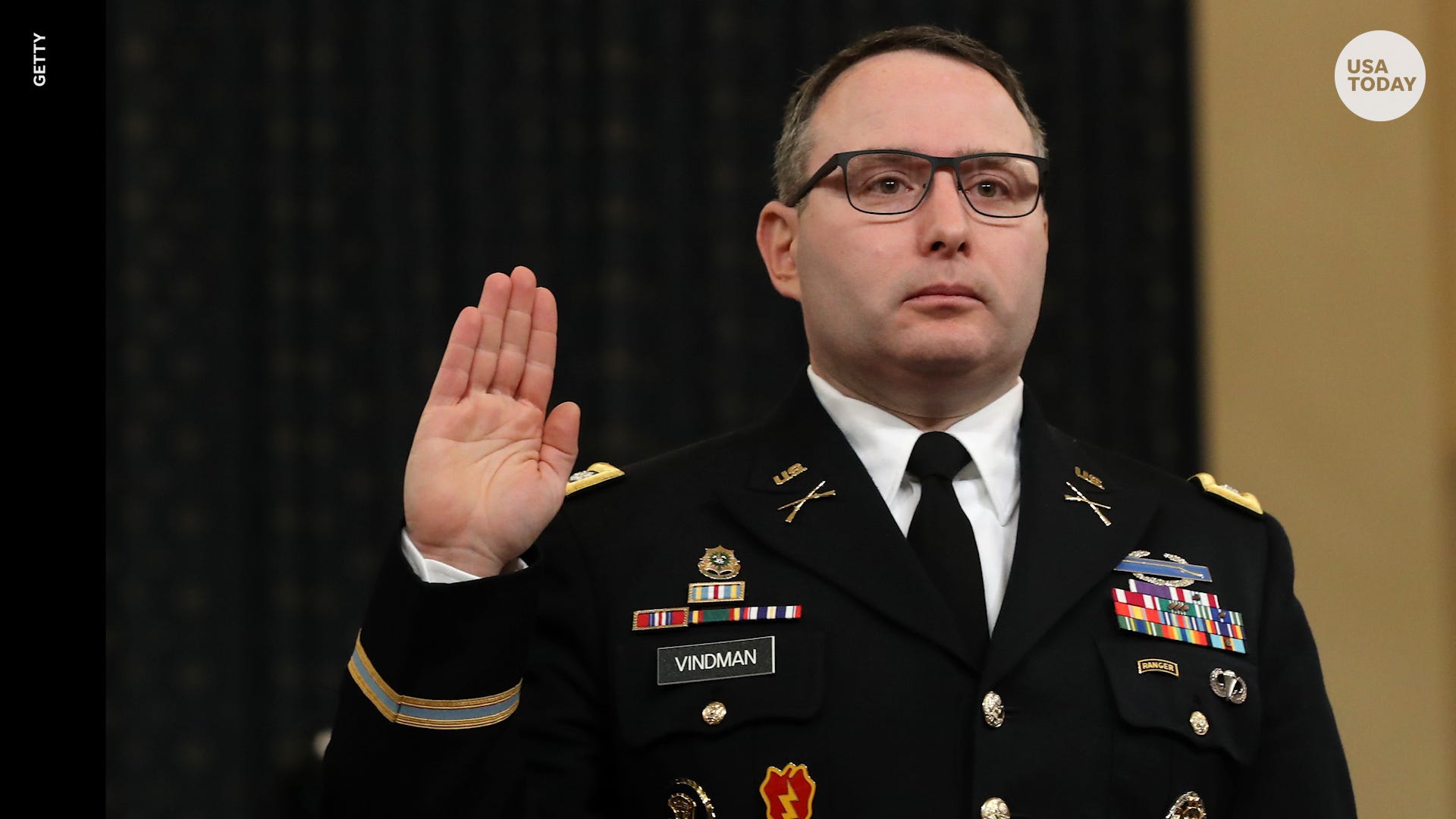


On Friday, Donald Trump dismissed Lt. Col. Alex Vindman from the National Security Council, months before his tenure was set to expire. Trump sacked Vindman, a Purple Heart recipient and the White House’s top expert on Ukraine, for his courageous testimony during impeachment proceedings in November, when he told Congress he’d reported his concerns about Trump’s now-notorious July 25 phone call with Ukrainian President Volodymyr Zelensky.
But who’s truly to blame for this naked act of thuggish retaliation? All 52 Republican senators who voted to acquit Trump for his abuses of power and desperate attempts to cover them up. Most especially, that includes the vulnerable Republicans who are up for re-election this November:
Susan Collins in Maine Joni Ernst in Iowa Cory Gardner in Colorado Kelly Loeffler in Georgia Martha McSally in Arizona David Perdue in Georgia Thom Tillis in North CarolinaCollins is particularly egregious: On Friday morning, before the Vindman news broke, she told reporters, “I obviously am not in favor of any kind of retribution against anyone who came forward with evidence.” What’s transpired since was not only predictable, it had in fact been predicted. Collins and her brethren knew what would happen as a consequence of vindicating Trump. They simply didn’t care.
We, however, do. Every time Trump does something awful from this day forward, we know whom to hold responsible. And we can ensure that his enablers go down to defeat this fall.
One would never know it by the post-Iowa media narrative of the Democratic race, but there is a fourth candidate in the top four coming out of Iowa. That candidate finished third, over-performing expectations and beating out the national front-runner. Wow! Who’s that?, you say. She’s a woman, tall and a touch lanky. She’s got a famous dog. Oh … right!
Seriously, the mainstream media counted Elizabeth Warren out before Iowa happened. Then when she claimed one of the three tickets heading out of Iowa, they counted her out again. The only stories I have seen for a solid four days now are about the jostling for first between Pete Buttigieg and Bernie Sanders and then an onslaught of stories perseverating over whether Joe Biden can rise from the dead. Since the mainstream media won’t write a single thing about Warren, I’m going to because, while Warren isn’t getting the post-Iowa boost that Buttigieg and Sanders are, I still think she’s got the best chance of building a coalition that can appeal to the broadest range of voters.
Here’s why: Buttigieg is gaining in New Hampshire and might pull out a first or second place win there. But he’s still nowhere with people of color. He’s got a wall once he hits more diverse states, South Carolina, in particular. Could that change? Perhaps, but we haven’t seen any evidence of that yet and his efforts to broaden his appeal have fallen flat so far.
Bernie’s theory of the case has always been that he can beat Trump because he will motivate more people to the polls, including an army of youth and other nontraditional voters, to vote for his revolution, as he calls it. He has continually polled strongest among voters under 30 and, to his credit, across a range of demographics. He was well organized in Iowa and his campaign predicted turnout there would rival that of 2008, when Barack Obama drew a whole new generation of voters to the polls. "I will tell you this without a shadow of a doubt,” Sanders said, heading into Iowa, “If there is a large voter turnout—if working people and young people come out in large numbers—we will win and win big." Sanders campaign spokesperson Mike Casca told Politico, “If there's a huge voter turnout, you can turn off your TV—Bernie won.”
Unfortunately for Democrats as a party, turnout was nowhere near ‘08 levels (roughly 240,000 caucusers), rather it was closer to 2016 levels (roughly 170,000 caucusers). The record-level turnout that the Sanders camp hyped doesn’t seem to have materialized. Perhaps to Sanders’ credit, turnout among voters under 30 appears to have increased slightly from 2008 levels. The Sanders camp also put serious energy into increasing participation with nontraditional voters by organizing satellite caucuses, which the campaign argues could still help Sanders edge out Buttigieg in the state delegate equivalent count. But any way you slice it, turnout was underwhelming and perhaps even concerning given the necessity of beating Donald Trump.
What that suggests is that bringing more voters into the fold as Sanders aimed to do isn’t enough. On the other hand, nominating someone who alienates Democrats’ most loyal voting bloc, as Buttigieg seems to, could produce exactly the type of turnout problems in the Rust Belt states that hobbled Hillary Clinton in ’16, not to mention the fact that it would make expanding the map very difficult for Democrats.
And while Joe Biden on paper seems to be the perfect candidate to hit both of those notes, on the stump he has proven to be uninspiring, which is exactly why he finished fourth in Iowa. Once voters really start paying attention to Biden, he fails to make the conversion. That was true even though both he and Buttigieg had a wide open state for two weeks while Sanders, Warren, and Amy Klobuchar were all stuck in Washington at Trump’s impeachment trial. Buttigieg was able to capitalize on that advantage, Biden wasn’t and it’s telling.
So who, you ask, could put together a coalition that motivates progressives, working class voters, and people of color, while still drawing cross-over votes among never-Trumpers? Warren. While Warren did not dominate hardly any counties across Iowa, her numbers were strong enough among a wide variety of voters and regions of the state that she pulled off a third-place finish. The fact that Warren actually outperformed expectations in Iowa is a story that has been completely ignored. She also remains third in national polling and third in FiveThirtyEight’s 2020 forecast behind Sanders (who got the biggest bump) and Biden for securing a majority of delegates to win the nomination.
Warren still edges out Buttigieg in the forecast, albeit by a single percentage point. As Nate Silver put it, “The case for Warren is that she's in 3rd place, more or less, and the Top 2 candidates aren't that far ahead of the pack and have big vulnerabilities.” All of which is to say, her complete erasure from the political discussion is curious to say the least. But as Democrats continue their quest for a candidate who can beat Trump, they need one that doesn’t turn off voters in any direction while having the fire in their belly for a fight over the long haul. Unless and until voting patterns and polling suggests otherwise, Warren is that person.
Warren’s overall appeal was apparent in two pre-Iowa polls: one showing that given the choice of nominating a candidate through the wave of a magic wand, voters chose Warren over every other Democratic candidate, which was also true in June 2019; and the other showing that Warren would be the least likely candidate to alienate Democrats if she were to win the nomination.
If you're a Democrat and could wave a magic wand�that would nominate any candidate for 2020, who you would pick? New polling by @Civiqs @DataProgress says: ***Elizabeth Warren*** That was true in June 2019, as well. Write up by @markhw_ https://t.co/UWVz9mRGjK pic.twitter.com/IfGKPzPWrJ
— meredith conroy (@sidney_b) February 3, 2020
If this poll is accurate @ewarren would be the most unifying nominee for Democratic voters. https://t.co/e6sFaUOihy
— Lawrence O'Donnell (@Lawrence) January 29, 2020
It's not that I think Warren is the perfect candidate, no candidate is ever perfect, as the recent exit of several staffers of color in her Nevada campaign demonstrates. It's just that I believe she has the best path to pull from all the demographics Democrats need to beat Trump, which includes both motivating nontraditional voters and attracting votes from high-propensity voters who don’t necessarily identify as Democrats. We will need every single vote we can get and, at this point, Warren bridges those gaps better than any other candidate in the field.
But whether Warren gets through the next few contests where other candidates have advantages is still an open question. Buttigieg is already getting a sizable bump in New Hampshire polling and Sanders just proved that he’s a fundraising juggernaut with a $25 million haul in January alone. Warren’s chances will likely depend on perhaps outperforming in one of the next several contests with a first- or second-place finish and remaining viable through Super Tuesday. But if Warren really does have a chance, don’t expect the mainstream media to let you know.
U.S. intelligence community leaders will not testify publicly or privately before House lawmakers next week about global threats, as negotiations on the timing and format of the annual hearing continue, according to people on both sides of the talks.
The Worldwide Threats hearing that takes place in the House and Senate has become an awkward source of tension after POLITICO first reported that intelligence officials pushed for the hearing that features both public and classified sessions to be moved entirely behind closed-doors over fears their bosses might provoke President Donald Trump’s ire.
“We are still in discussions with the IC, and look forward to their agreeing to attend the one public oversight hearing with all major IC agencies the Committee holds each year,” a House Intelligence Committee official told POLITICO.
Last year’s public hearing before the Senate Intelligence Committee saw the chiefs from NSA, CIA and other agencies present findings that split from many of the president’s public statements on North Korea, Iran and Russia.
Trump later lashed out at them on Twitter, suggesting the leaders “go back to school.”
The day after POLITICO’s report, House Intelligence Chairman Adam Schiff (D-Calif.) invited intelligence agency leaders to appear before his panel on Feb. 12.
“The hearing provides an opportunity for I.C. seniors to provide an unclassified, yet important broad understanding of how threats have evolved and what the nation can expect in the year to come,” Schiff wrote in a letter to acting Director of National Intelligence Joseph Maguire.
Congressional sources told POLITICO that the clandestine community would still prefer the testimony be entirely classified but aren’t aggressively pursuing the argument in the face of bipartisan resistance in both chambers. People familiar with the talks asked not to be named in order to speak freely about the ongoing negotiations.
An ODNI spokesperson said that “we are still having productive discussions with the committees on the timing of the Worldwide Threat Assessment hearings.”
One Capitol Hill source said the agency chiefs would likely prefer to appear before the GOP-controlled Senate Intelligence Committee first to avoid the hyper-partisanship that has seized its House counterpart in recent years, and in the hope the session would focus on the top threats to the nation without careening into other topics.
Indeed, since Schiff sent his invite, he has alleged that the NSA and CIA may be withholding documents on Ukraine from Congress due to pressure from the White House.
The last time Maguire testified publicly was in October, when he appeared before Schiff’s panel for a tense session over his handling of the whistleblower complaint that exposed Trump’s political pressure campaign on Ukraine, which sparked impeachment proceedings.
A House Judiciary Committee hearing this week with FBI Director Christopher Wray signaled that the president’s congressional allies remain eager to grill national security leaders over missteps dating back to the 2016 election.
Wray’s congressional appearance was his first since the Justice Department inspector general report that chastised the FBI’s monitoring of former Trump campaign aide Carter Page and GOP lawmakers hammered him repeatedly over the watchdog’s findings.
“The failures highlighted in that report are unacceptable. Period. … It cannot be repeated,” Wray said during the nearly five-hour hearing. “I do not think anyone has carte blanche to bypass rules, and I intend to make that painfully clear, that that is not acceptable in the FBI today.”
Now that Trump’s impeachment trial has wrapped in the Senate, it should be easier for the panel to schedule the annual assessment from the intelligence community, which usually takes place anytime between February and May.
A spokesperson for Chairman Richard Burr (R-N.C.) declined to comment.